ASDM Digital Library for Kids!

ASDM Home
Search
Saguaro Cactus
English Name:
Saguaro Cactus
Spanish Name:
sahuaro
Scientific Name:
Carnegiea gigantea
Photographer:
Mark A. Dimmitt
Copyright:
© 2003 ASDM


Identifying Features

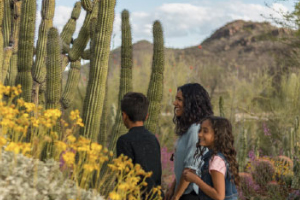
The saguaro cactus (Carnegiea gigantea) is one of the defining plants of the Sonoran Desert. These plants are large, tree-like columnar cacti that develop branches (or arms) as they age, although some never grow arms. These arms generally bend upward and can number over 25. Saguaros are covered with protective spines, white flowers in the late spring, and red fruit in summer.

Habitat

Saguaros are found exclusively in the Sonoran Desert. The most important factors for growth are water and temperature. If the elevation is too high, the cold weather and frost can kill the saguaro. Although the the Sonoran Desert experiences both winter and summer rains, it is thought that the Saguaro obtains most of its moisture during the summer rainy season.

Range

You find this cactus in southern Arizona and western Sonora, Mexico. At the northern portion of their range they are more plentiful on the warmer south facing slopes. A few stray plants can also be found in southeast California.

Wild Status

The saguaro is not currently listed as threatened or endangered. Arizona has strict regulations about the harvesting, collection or destruction of this species.

Life Span

With the right growing conditions, it is estimated that saguaros can live to be as much as 150-200 years old.

Size

Saguaro are very slow growing cactus. A 10 year old plant might only be 1.5 inches tall. Saguaro can grow to be between 40-60 feet tall (12-18m). When rain is plentiful and the saguaro is fully hydrated it can weigh between 3200-4800 pounds.

Extra Fun-facts

The saguaro is the largest cactus in the United States.

Most of the saguaros roots are only 4-6 inches deep and radiate out as far from the plant as it is tall. There is one deep root, or tap root that extends down into the ground more than 2 feet.

After the saguaro dies its woody ribs can be used to build roofs, fences, and parts of furniture. The holes that birds nested in or “saguaro boots” can be found among the dead saguaros. Native Americans used these as water containers long before the canteen was available.

Saguaro flowers bloom for less than 24 hours. They open at night and remain open through the next day. They only have that very short time to attract an animal to be pollinated.

Fun Facts: Saguaro Cactus

Fun Facts: Saguaro Cactus

ASDM Sonoran Desert Digital Library for kids © 2011 Arizona-Sonora Desert Museum